


 Passage grave
Description
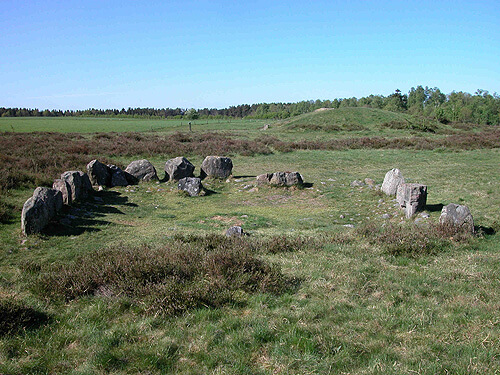
In today's landscape, most visible ancient monuments are scattered individual elements from a bygone era. On the small plateau south of Hevring River, about 1.4 km west of Tustrup town in Norddjursland, the situation is different. Here, there is a whole collection of typical burial monuments from the first farming culture of the Stone Age – the so-called Funnel Beaker Culture – from around 3,200 BC.

At the burial site, with only about 100 m between them, there are two stone cairns and one of Denmark's largest megalithic tombs around a central structure – the so-called cult house. The cairns and passage grave have been known since their construction due to their visibility, but it was not until extensive excavations in 1954-57 that detailed knowledge about the individual structures and their connection to the previously unknown coal house was established.

When the burial site was in use almost 5,000 years ago, the landscape looked very different. It was then covered by dense deciduous forest, which the Stone Age people began to clear to create small clearings for fields. Hevring Å, which today is only a small stream, was then a water-rich river that flowed just a few kilometers downstream into the fjord system that connected Kolindsund with the Kattegat via Randers Fjord and the fjord opening at Hevring Hede. The moraine hills from Ørsted to Udbyhøj were thus at that time a large island in the Stone Age sea, and the coasts of Djursland were more like an archipelago with countless small islands, straits, headlands, fjords, and islets.

At the Tustrup burial site, the 5 x 5.5 m coal house with an open northeast gable was probably the center of activity at the burial site. With its stone-lined box walls and large stones along the back wall, as well as the lack of a hearth, the building style is much more reminiscent of the large stone graves than the wooden dwellings of the Funnel Beaker Culture.

On the floor up to the southwest-facing back wall, the excavation revealed shards from 28 beautiful clay pots, which are identical to the pottery that gave the Funnel Beaker Culture its name and was used for offerings in front of and inside the dolmens and the megalithic tomb. The house is therefore interpreted as a kind of temple where, for example, the deceased were placed while the graves were being built, and around which the cultic activities were centered. Tustrup was the first place where such a house was found.

Similar cult houses have since been found in several other places, including Ferslev in North Jutland. Moesgård Museum was in charge of the excavations. In the museum's exhibition, you can see the finds from the site, and in the nearby ancient park, a reconstruction of the cult house has been erected.

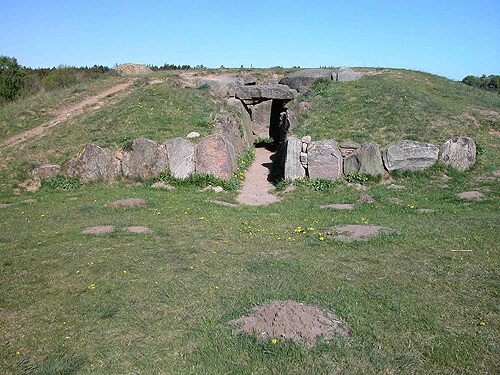
Southwest of the cult house lies the large megalithic tomb, which, with its 3 x 10 m burial chamber, is among the largest in Denmark. Megalithic tombs are the Stone Age people's largest form of burial. It was built as a communal grave and was usually used repeatedly by both the Funnel Beaker Culture and later cultures.

A 6 m long passageway leads to the burial chamber. Originally, the passageway was covered with large stones, just like the burial chamber. Impressively large stones (4) were used in its construction, and of the beautiful large stone graves at Tustrup, the dolmen in particular represents an enormous amount of work and a thought-provoking investment of both materials and labor. A total of 40 large boulders weighing between ½ and approx. 20 tons were used in its construction.

Of the many architectural details in the megalithic tomb, the vertically placed frame stones at the transition between the passage and the chamber, as well as the "key stone" above, which distributes the pressure from the chamber's capstone to the passage, are particularly noteworthy. In both the passageway and the burial chamber, massive "dry walls" of stacked flat stones fill the spaces between the supporting stones, and on the floor at the northern end of the burial chamber, there is a frame of flat stones placed on edge, marking a special area that may have been reserved for the burial of special individuals.

Perhaps the greatest experience at the megalithic tomb today – and a sure "hit" for children in particular – is to crawl into the so-called side chamber with a flashlight. The opening to this chamber is located in the southwest corner of the main chamber between two supporting stones, and inside, the darkness and fantastic construction of the megalithic tomb can be felt intensely. Similar side chambers are found in only 26 of the 700 or so megalithic tombs remaining in Denmark. The side chamber was built at the same time as the rest of the megalithic tomb, and there must have been an idea or thought behind it: perhaps this is where the local chieftain's family was buried!

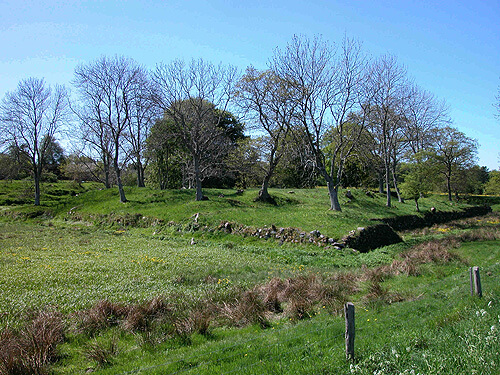
The two other large stone graves at Tustrup are both stone cairns with polygonal burial chambers. The dolmens are traditionally considered predecessors to the large passage grave, but the pottery finds from the excavations of the graves were of the same nature as those found in both the charcoal kiln and the passage grave, which is why the graves must have been in use at the same time.
Northwest of the charcoal kiln is a free-standing cairn chamber with five of the original six supporting stones and a short southwest-facing passageway with two supporting stones. On the floor at the transition between the passageway and the chamber is a so-called "threshold stone," which marks where the inner wooden or stone door to the chamber was located.

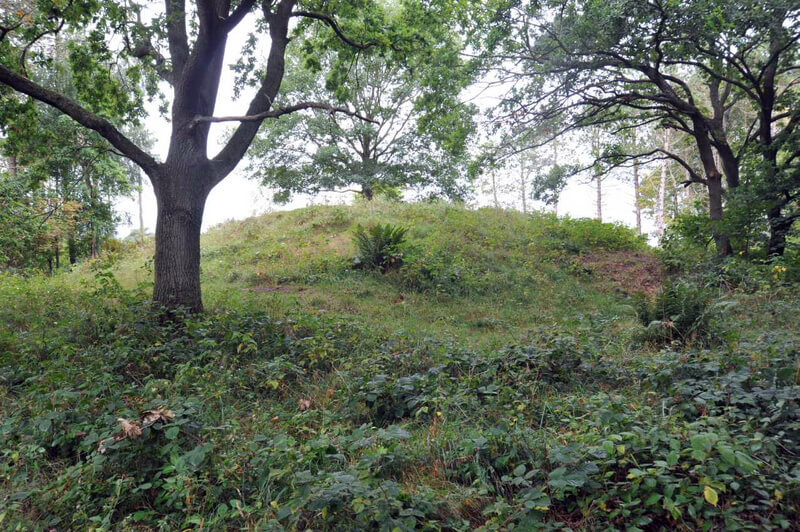
The very beautiful round barrow southeast of the charcoal kiln has no chamber passage. The opening to the chamber is simply a gap between two of the chamber's five supporting stones. The round barrow was restored and rebuilt in 1994 in accordance with previous excavations in order to give visitors the experience of an intact round barrow, in contrast to the rather damaged free-standing burial chamber. Along the foot of the mound (9) that surrounds the burial chamber are 13 large kerbstones with an impressive dry stone wall. The capstone over the chamber and parts of the dry stone wall and mound were added in 1994, and outside the chamber opening lies a stone from the cairn with clear chisel marks from recent stone cutting in the area. Large stones have always been a sought-after building material – perhaps for the construction of the nearby ashlar church in Nørager or for use as gravel in nearby roads or railways.

In addition to its ancient monuments, the Tustrup area offers beautiful nature with marked trails and a primitive campsite close to the information building at the westernmost parking lot. The area is, in collaboration between Aarhus County and Rougsø Municipality (now Norddjurs Municipality), which owns the area, under constant nature conservation with the aim of restoring vegetation that harmonizes as well as possible with the Stone Age vegetation and to highlight the area's varied landscape. Just northeast of the burial site, for example, there is a now overgrown bog, which had an open water surface when the burial site was in use and which therefore also holds significant archaeological and botanical interest.
Access
- Følg skiltning ”Stendysserne” fra Nordkystvejen, vej 547: Randers-Grenå mellem Vivild og Fjellerup, eller fra Nørager frem til parkeringspladsen nord for Hevring å.
Faciliteter
- 2 parkeringspladser og afmærket lokal stirute gennem området.
- Informationsskiltning ved fortidsminderne.
- Ved den vestlige parkeringsplads forefindes offentligt toilet i en informationsbygning som rummer en illustrativ plancheudstilling over fortidsminderne og lokalområdet, samt en inspirerende og børnevenlig landskabsmodel og rekonstruktion af Tustrup-gravpladsen i stenalderen.
- Primitiv overnatningsplads og bålsted ca. 150 m. syd for informationsbygningen.
- Stedet er yderst velegnet som eskurtions- og udflugtsmål.
- Afstand til fortidsminde: ca. 250 m.
Særlige forhold
- Vis hensyn til græssende dyr på området: Luk hegn og låger.
- Der må kun afbrændes bål på den primitive lejrplads og vis stor hensyn til brandfaren på hele området.
- Hund skal føres i snor.
- Der er handicapadgang til informationsbygningen.
Directions
Related literature

348 oldtidsminder i Jylland
Henning Dehn-Nielsen

Guide til Danske fortidsminder
Carsten Henrik Bang

Fortidsminder i Danmark
Hennning Dehn-Nielsen

Danmarks oldtid
Karsten Kjer Mikkelsen

Kirkerne på Djursland
Inger Hørup

Natur og Kulturguide til Århus Amt
Poul Henning Jensen

Vejviser til Danmarks Oldtid
Ingrid Falktoft Andersen

Danmarkshistorien bind 1-2, Stenalderen
-
Danske Oldtidsminder
P.V. Glob

Jættestuer i Danmark
Svend Hansen

KUML
-

SKALK
Christian Adamsen / Jørgen Kraglund

På tur i Djurslands fortid
Karsten Kristiansen
Tustrup oldtidsminder
Karsten Kristiansen
Kolindsund - et stykke Djursland fortæller danmarkshistorie
Brita Flou m.fl.

Danmarks Oldtid, Stenalderen
Johannes Brøndsted

Stendysser - Arkitektur og funktion
Palle Eriksen & Niels H. Andersen

Stenaldergrave gennem 300 år
-

Tempelhus fra stenalderen
Poul Kjærum
Storstensgrave ved Tustrup
Poul Kjærum
Aerial Photo
Remember when visiting
- Keep dogs on a leash — avoid contact with grazing animals
- Avoid wear damage and always follow signage
- Never dig at or near ancient monuments
- Be aware of fire hazards — never use open flames
- Contact the supervisory authority in case of damage or problems
Administration
- Ownership
- Norddjurs Municipality
- Created
- 2020
- Last edited
- 02-2026
- Inspection and damage
- The Danish Agency for Cultural Heritage
- Care, signage and 100m zone
- Norddjurs Municipality
- Protection no.
- 1916-8
- Site no.
- 141013-66
Find the monument with GPS
- GPS:
-
Longitude: 10.512913Latitude: 56.490520
- UTM system:
- E 593154 N 6261701
Vidste du...
Flintminer ved Hov i Thy er blandt de ældste "fabrikker" i Danmark, hvor stenalderfolk gravede flint ud af kridtundergrunden.
Stenalder