


 Ruin
Ruin
Description
The royal castle at Kalø at the bottom of Aarhus Bay and Kalø Vig is one of our best-preserved medieval castles.
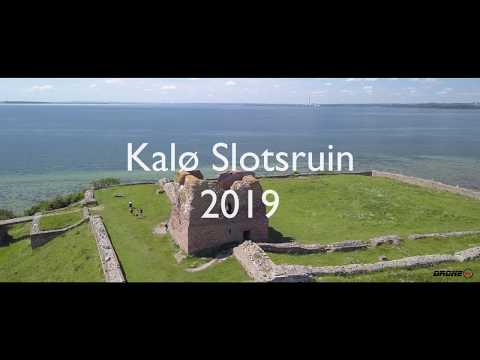

It is well worth a visit, both for the castle itself and the surrounding countryside.

The castle was built in 1313 by King Erik Menved as one of a total of four Jutland "compulsory castles." In 1313, Erik Menved had defeated the Jutland peasant uprising against the king's many wars and the resulting heavy taxes. From the castles, the royal power could control and tax the local area and prevent new rebellions. The three other contemporary castles are "Borgvold" near Viborg, "Bygholm" near Horsens, and "Ulstrup" near Struer.

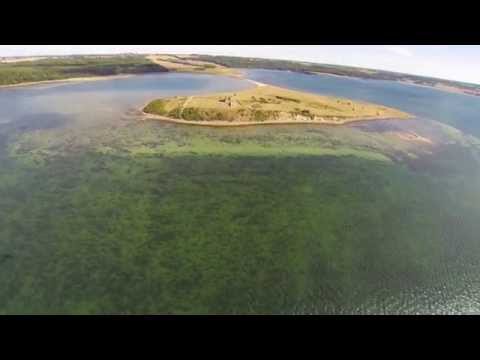
The castle at Kalø is built in an isolated and strategic location on top of a natural island, offering a fantastic view of Kalø Vig, Aarhus Bay, and the surrounding countryside.
The only access route by land is the almost 500 m long, artificially constructed causeway from the mainland northeast of Kalø. Originally, the road was separated from the castle by a drawbridge near the castle. Today, the causeway is the best preserved and longest medieval road in Denmark.

In the beach meadow west of the causeway on the mainland side, you can see the tree-covered "Grevens Skanse" (the Count's Fortification), whose exact function, background, and history are unfortunately unknown.

The sea protects the castle on all other sides. Egens Vig, within the large stone reef "Rønsten" that stretches southeast of the castle, forms a fantastically well-protected natural harbor, which was also used at that time. Sailing around the castle has always required extensive local knowledge, as there are only two narrow passages through the reef, the closest of which to Kalø is up to 11 m deep.

The current ruins at Kalø are the result of several centuries of construction. Only remnants of the first castle remain beneath the current ruins.

Among other things, traces of a round corner tower have been found in the northern corner of the current ring wall, and perhaps part of the large tower that still marks the ruins is also from this period.

The building ruins seen today mainly date from the castle's expansion under King Valdemar Atterdag. He redeemed the castle, which until 1343 had been mortgaged to the Counts of Holstein. At the end of his reign, however, it was mortgaged again, this time to the bishop of Aarhus. The bishop of Aarhus owned the castle and the associated taxes and duties until 1407, when the mortgage was redeemed again by Valdemar Atterdag's daughter Margrethe I.

At the end of the Middle Ages, in the first half of the 16th century, Kalø lost its military significance.
After that, it functioned mainly as an administrative center and seat of the bailiff for the four districts of Djursland. The castle was used to collect the king's taxes and duties, and it also served as a prison. The most famous prisoner was Gustav Vasa, who later, in 1521, became king of Sweden. He was taken prisoner by King Christian II until 1519, when he managed to escape disguised as a cattle driver. The priest Søren Quist, known from St. St. Blicher's short story "The Priest in Vejlby," is another well-known prisoner at Kalø, where he was imprisoned until his execution in 1626. In the 1600s, Kalø also took an active part in the witch trials.
With the introduction of absolute monarchy in 1660, the division of counties was abolished in favor of counties. In 1672, King Christian V gave Kalø to his son Ulrik Frederik Gyldenløve, who subsequently had the buildings demolished. The building materials were reused in the construction of Charlottenborg at Kongens Nytorv in Copenhagen.

There are several legends associated with Kalø. A wandering legend, also known from other places in Denmark, tells that a large treasure equivalent to seven years' tax revenue is buried at Kalø. The treasure is guarded by a large dragon at the castle, whose tail can sometimes be seen. The legend should, of course, be seen in the light of the repeated mortgaging and turbulent ownership that Kalø has experienced over time.
Another story tells that during a long siege, only one cow and one pig remained at Kalø. The cow was then pulled to the castle's well countless times during the day, covered with one of the many hides from the already slaughtered cows, and the pig was stabbed so that it squealed all day long. This led the enemy to believe that there was still enough food in the castle, and they therefore abandoned their venture.


LINK: See more about Kalø Castle Ruins on the National Museum's website.
LINK: Watch a video from a flight over the ruins of Kalø Castle.
Video (3)
Dronetur over Kalø Slotsruin
Flyvetur over Kalø Slotsruin
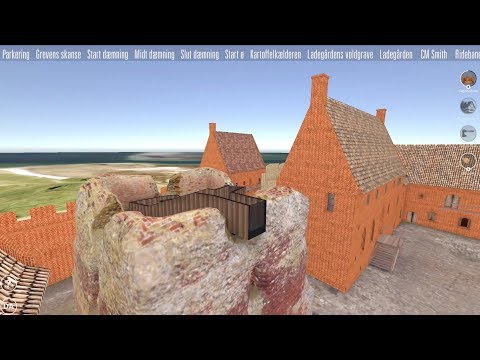
Rekonstruktion af Kalø Slotsruin
Access
- In Rønde town, turn onto Kaløvej towards Ebeltoft.
- Follow the road for approx. 2 km to the large parking lot at the foot of the dam leading to the castle ruins.
Facilities
- Public toilet, restaurant, kiosk, and parking lot
- Free information leaflets in the leaflet box.
- Detailed guidebook sold at the kiosk.
- Information signs at the parking lot and the ruins.
- Distance to historical site: approx. 1.5 km.
Special conditions
- In good weather, Kalø Castle Ruins is an ideal place for a picnic.
- Remember to wear sensible footwear and clothing for the walk to the ruins.
- Dogs must be kept on a leash.
- Please be mindful of grazing cattle in the area.
Directions
Related literature

Bevar din arv
Ingrid Nielsen (red.)

Borge i Danmark
Rikke Agnete Olsen

Guide til Danske fortidsminder
Carsten Henrik Bang

Kalø-guide
Kirsten Meldgaard

Fortidsminder i Danmark
Hennning Dehn-Nielsen

Middelalderen i Danmark
Nils-Knud Liebgott

Borg og vold
Jan Kock

Natur og Kulturguide til Århus Amt
Poul Henning Jensen

Vejviser til Danmarks Oldtid
Ingrid Falktoft Andersen

Danmarkshistorien bind 9-11, Middelalderen
-

Danske høje fra sagn og tro
Mads Lidegaard

Danske voldsteder: fra oldtid og middelalder
Vilhelm La Cour

Voldsteder i Danmark - en vejviser
Rikke Agnete Olsen m.fl.

Kongens borg på Kalø - Nye undersøgelser
Nils Engberg, Vivian Etting og Marianne Greve Iversen
Vandreture i Statsskovene
Naturstyrelsen
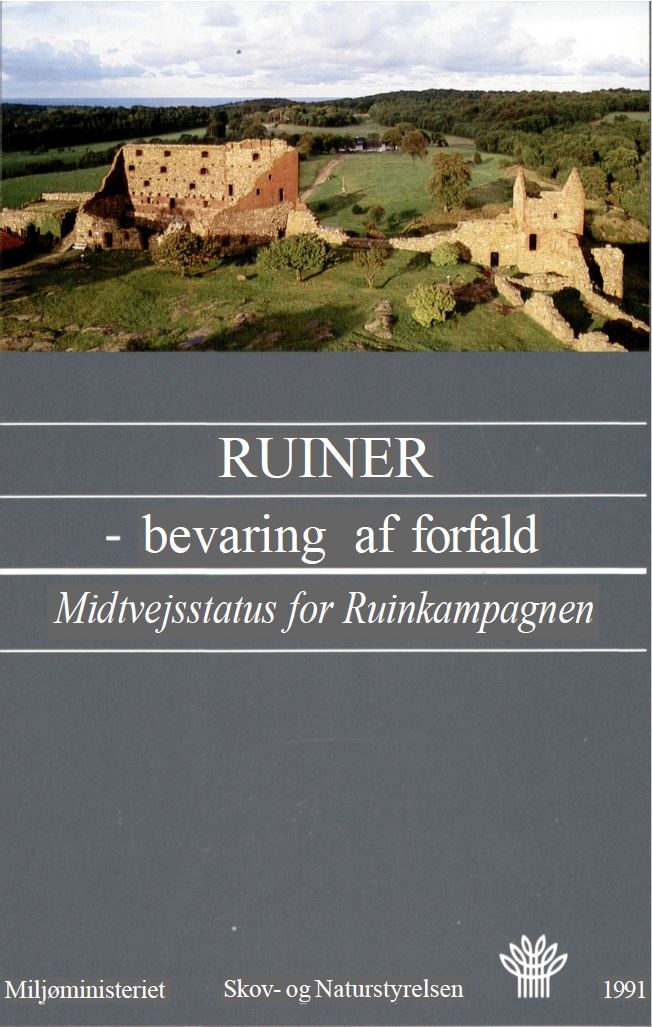
Ruiner - Bevaring af forfald
Skov- og Naturstyrelsen

I krigens fodspor - forsvarsbyggerier i Danmark
Flere forfattere

Mols Bjerge

Kalø Slotsruin - Billeder

Kalø Slot
Aerial Photo
Remember when visiting
- Keep dogs on a leash — avoid contact with grazing animals
- Avoid wear damage and always follow signage
- Never dig at or near ancient monuments
- Be aware of fire hazards — never use open flames
- Contact the supervisory authority in case of damage or problems
Administration
- Ownership
- State-owned
- Created
- 2020
- Last edited
- 02-2026
- Inspection and damage
- -
- Care, signage and 100m zone
- The Danish Forest and Nature Agency
- Protection no.
- 2316-42
- Site no.
- 141101-62
Find the monument with GPS
- GPS:
-
Longitude: 10.466666Latitude: 56.274636
- UTM system:
- E 590819 N 6237613

Vidste du...
De ældste spor af mennesker i Danmark er ca. 14.000 år gamle og stammer fra jægere, der fulgte rensdyrene nordpå efter istiden.
Stenalder