



 Channel
Description
Welcome to Møllediget near Sorø
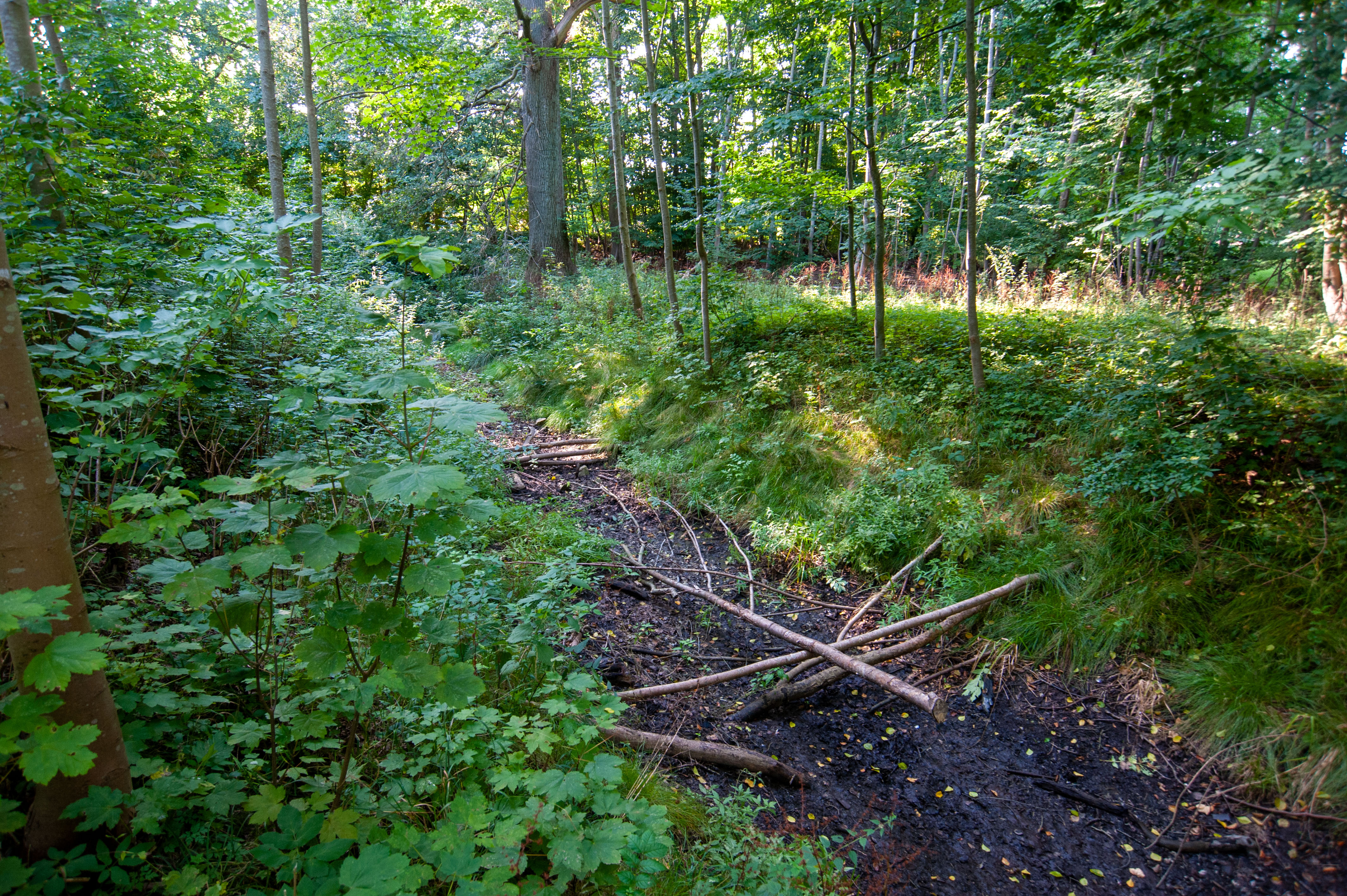
Møllediget is an extensive medieval structure. Compared to the usual protected ancient monuments in the countryside (burial mounds, dolmens, fortifications, etc.), the approximately 2.2 km long canal is a large and complex structure. Approximately 1.5 km of the canal between Ringstedvej in the north and Ingemannsvej in the south has been preserved to this day and is listed. To the north, around the canal's outlet in Tuelsø, modern development has removed around 400 m of the canal, and to the south, at Sorø Academy, Sorø Lake, and the old watermill, the academy's buildings and gardens have transformed the landscape and the former mill canal. However, archaeological excavations over the last 50 years have to some extent uncovered the course of the canal on the monastery grounds.
The canal was part of an extensive water regulation system that was established in the area in connection with the construction of Sorø Monastery in the early 13th century. The Cistercian monks at the monastery worked purposefully to harness water power and made a major contribution to the development of watermill operations in Denmark. See also Alling Monastery and Øm Monastery
Innovative monasteries
The canal is referred to as "Møllediget" (the mill dike) because the Old Norse meaning of dike was the same as a ditch. The purpose of the canal was to divert water from the mill and monastery at the dammed Sorø Lake, which ensured a stable water supply to the mill at the monastery at the southern end of the canal. The canal flowed into the lower-lying Tuelsø, which in its further course drained naturally through Tuelå, Susåen, and Tystrup Sø to the outlet into the sea at Næstved.
The monasteries were of crucial importance to the technical development of Danish society. In addition to the religious influence and way of life of the monasteries, brick burning, milling, Latin writing, and paper, for example, were introduced by the monks in the many monasteries, which before the Reformation in 1536 also quickly became the country's largest landowners.
Mill operation was of crucial importance to the local community, as the mill was used to grind grain and thus also had an impact on both food supply and the economy.
The construction of the mill canal included not only the dike, but also water regulation of the surrounding lakes and the establishment and control of associated sluices, which together formed a well-organized technical facility. All of this had a major impact on the water level in Sorø Lake and the surrounding meadows and lowlands.
Great technical insight and precise execution
The mill canal and the associated weirs are an impressive piece of engineering, rooted in the monks' deep technical insight and skill – and which certainly also required extensive preparatory work and analysis of the surrounding terrain. The canal's precise construction, with a carefully measured gradient of only 3 cm per 100 m length of the canal, is particularly impressive. In total, this gave the canal a gradient of only about 60 cm, which was sufficient to drain water from the mill and the monastery, but at the same time did not cause unnecessary erosion of the sides and bottom of the canal, with the consequent risk of the canal banks collapsing. The scale of the construction work is also impressive. A total of 30,000 m3 of earth was dug out manually with shovels and placed in an embankment along the east side of the canal, where the gravel road – today known as "Filosofgang" – runs.
The first mill at the monastery was of the early type – a so-called "underfall mill." Here, the lower part of a vertically positioned mill wheel was driven by the water power of the flowing water in the canal. Later and much more efficient types of mills: "breastfall and overshot mills" can be assumed to have replaced this early type, which made poor use of the water power – see more about this on the information boards along the canal, which you can also download here on the website.
The Sunesønnerne and the mill dam
The construction of the mill canal and Sorø Mill was a large and costly project, and here too the monks showed great ingenuity. Many people donated large sums to the monastery in the hope of better salvation and reconciliation after death. In the Middle Ages, the Catholic Church even created so-called "letters of indulgence," where both high and low persons, in exchange for payment, could secure a short stay in Purgatory and thus more direct access to Heaven.
The Sorø Monastery's gift book tells us that in 1186, Sune Ebbesen bequeathed 1/17th of all his possessions to the monastery. Sune was the cousin of the monastery's founder, Bishop Absalon (see also Fjenneslev Ruins), and after his death and years of negotiations, the inheritance case was finally settled when his sons - Peder Sunesen (Bishop of Roskilde) and Anders Sunesen (Archbishop of Lund) - instead fulfilled this obligation by paying for the excavation of the mill canal. The mill dike is therefore also referred to as "Sunesønnernes mølledige" (the Sunesons' mill dike).
The mill canal after the Reformation
After the Reformation in 1536, the property of Sorø Monastery passed to the crown and later to Sorø Academy. During this period, the use of the waterworks gradually changed, and over time the mill dam lost its original function. However, the canal and mill were in use for more than 500 years until its closure around 1749. After this, the larger windmills around the market town took over the task of grinding grain.
Today, Møllediget stands out as a striking feature of the landscape and an important testament to medieval water technology and the historical development of Sorø. The canal is an important element in understanding Sorø's cultural heritage and the interaction between nature, technology, and settlement over the centuries.
-----------------------------------------------------------------------------------------------------------
See more about Møllediget and many other locations in Sorø at Sorøleksikon.
Here you will find a copy of the article "Møllediget i Sorø" (The Mill Dike in Sorø).
Access
Access to Møllediget is possible on foot or by bicycle via Filosofgangen, the gravel road along the east side of the canal.
The best way to access Filosofgangen is via Jernporten on Ringstedvej or via Fægangen and Skælskørvej near Sorø Academy.
Remember to keep dogs on a leash and refrain from leaving litter behind during your visit.
Directions
Related literature

Aerial Photo
Remember when visiting
- Keep dogs on a leash — avoid contact with grazing animals
- Avoid wear damage and always follow signage
- Never dig at or near ancient monuments
- Be aware of fire hazards — never use open flames
- Contact the supervisory authority in case of damage or problems
Administration
- Ownership
- Sorø Academy Foundation
- Created
- 2026
- Last edited
- 02-2026
- Inspection and damage
- Danish Agency for Culture and Palaces
- Care, signage and 100m zone
- Sorø Municipality
- Protection no.
- 3524-34
- Site no.
- 040111-22
Find the monument with GPS
- GPS:
-
Longitude: 11.572695Latitude: 55.435982
- UTM system:
- E 662763 N 6146319
Nearby


Vidste du...
Fundet ved Tybrind Vig på Fyn afslørede 7.000 år gamle udhuggede kanoer, tekstiler og endda tygget "tyggegummi" af birketjære.
Stenalder