


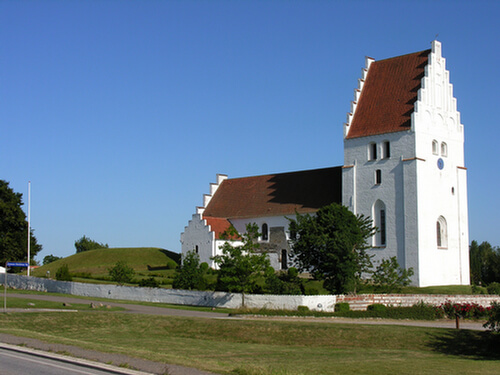
 Burial mound
Description
The large burial mound at Elmelunde Church
Elmelunde Church, the oldest stone church on Møn, is best known for its impressive frescoes, but the cemetery east of the church also features a monumental burial mound measuring approximately 20 x 3 meters. The mound has never been excavated, so its exact age is unknown.

The first description of the mound by the National Museum in 1880 mentions that "according to old traditions" masonry was found during the excavation of the mound. Whether the mound contains masonry is unknown and can only be clarified by an archaeological excavation. However, if this is the case, the mound could be an old (but unknown) fortification, probably from the Middle Ages. This is contradicted by the fact that Elmelunde Church was founded as early as 1085.

The connection between ancient burial mounds and later churches is known from about 100 Danish churches – see also, for example, Rimsø and Krogsbæk. The best known are the two mounds at Jelling with the graves of King Gorm and Queen Thyra, which Harald Bluetooth later moved to the first Christian church he built in Jelling.

Traditionally, the large burial mounds near churches were considered to be mounds from the Viking Age, as in Jelling, but recent excavations, including those in Hohøj near Mariager, have shown that the large mounds could well date from the Bronze Age. Due to the high location of the Elmenlunde burial mound, about 40 m above sea level and with a wide view in all directions, it can also be assumed that this burial mound is one of the very large mounds built of peat that were erected in the landscape. As it is located at an altitude of 40 m above sea level and offers a wide view in all directions, it can be assumed that this burial mound is one of the very large peat mounds that were built on the highest points of the landscape in the first centuries of the early Bronze Age after 1700 BC.

The close connection between the burial mound and the church in Elmelunde represents the continuous use of the site as a sacred place in both pagan and Christian times. When the Christian faith was introduced to Denmark during the Viking Age around 800 AD, the mound had probably already existed for almost 1000 years. The mound's function as a burial site and gathering place was undoubtedly known and may have been used in the meantime for additional burials in the old mound, as is often the case with large mounds from the Bronze Age in particular.

The Viking Age was a time of transition between pagan and Christian beliefs, and it was during this period that the first simple wooden churches were built. The present church in Elmelunde, founded in 1085, undoubtedly had one or more predecessors, as is known from Lisbjerg near Aarhus and Hørning on Djursland, where the simple wooden churches were later replaced by massive Romanesque stone churches.

Elmelunde Church used to serve as a landmark and reference point for sailors, and it is quite possible that the burial mound in front of the church had the same function. The flat top of the burial mound also suggests that the site was used as a meeting and ceremonial place.

Many similar mounds were used as places of execution in both the Middle Ages and more recent times, which is why many burial mounds were given the name "Galgehøj" (gallows hill). A third secondary function of the high burial mounds was their use as signal points. Many mounds bear the name "Bavnehøj" (signal mound) because they served as signal points where fires (baune) were lit and could be used, for example, in times of unrest to communicate over long distances that the enemy was "at the door."

When you visit the burial mound, be sure to take a look inside the church. Elmelunde Church has some of the most beautiful frescoes in Denmark. They were painted around 1500 by the Elmelunde workshop, which also decorated the churches in Keldby and Fanefjord. The paintings were uncovered in 1887 by conservators from the National Museum after having been whitewashed.

You can learn more about the frescoes and the history and use of the church on the Elmelunde Church website. There you will also find an interactive panoramic photo of the frescoes so you can explore them yourself. Only the central section with the triumphal
arch and the longitudinal walls remain of the original Romanesque church. The other parts are later additions that were added over time, most recently around 1700. The building materials used are very special: chalk and limestone, granite, flint, and bog iron, as well as fired monk tiles.

Access
- Elmelunde gravhøj ligger på kirkegården ved Elmelunde Kirke i Elmelunde midt på Møn.
- Følg landevej 287 ca. 7 km. mod øst fra Stege til Elmelunde.
- Parker på offentlig P-plads ved kirken
Faciliteter
- Informationsskilt ved gravhøjen.
- Afstand til fortidsminde: 80 m.
Særlige forhold
- Husk også at aflægge et besøg i kirken og oplev de fantastiske kalkmalerier.
Directions
Related literature

Guide til Danske fortidsminder
Carsten Henrik Bang

Fortidsminder i Danmark
Hennning Dehn-Nielsen

Middelalderen i Danmark
Nils-Knud Liebgott

356 Oldtidsminder på øerne
Henning Dehn Nielsen

Vejviser til Danmarks Oldtid
Ingrid Falktoft Andersen

Danmarkshistorien bind 3-4, Bronzealderen
-

Højfolket
P.V. Glob

Danmarks Oldtid. Bronzealderen
Johannes Brøndsted

Kalkmalerier.dk

Elmelunde Kirke
Aerial Photo
Remember when visiting
- Keep dogs on a leash — avoid contact with grazing animals
- Avoid wear damage and always follow signage
- Never dig at or near ancient monuments
- Be aware of fire hazards — never use open flames
- Contact the supervisory authority in case of damage or problems
Administration
- Ownership
- Ministry of Church Affairs, Elmelunde Church
- Created
- 2020
- Last edited
- 02-2026
- Inspection and damage
- The Danish Agency for Cultural Heritage
- Care, signage and 100m zone
- Vordingborg Municipality
- Protection no.
- 4129-11
- Site no.
- 050504-35
Find the monument with GPS
- GPS:
-
Longitude: 12.401260Latitude: 54.995153
- UTM system:
- E 717556 N 6099544
Vidste du...
Guldhornene fra Gallehus (ca. 400 e.Kr.) blev fundet i 1639 og 1734, men stjålet og smeltet om i 1802. Kopierne kan ses på Nationalmuseet.
Arkæologiske fund