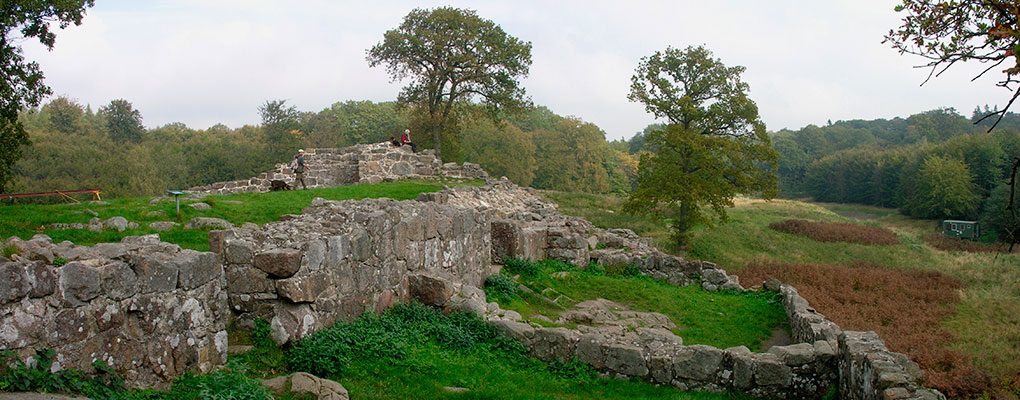
Middle Ages
Urbanization, monasteries, and trade
Throughout the Viking Age, Danish society expanded rapidly. Royal power, Christianity, towns, and castles made their entrance, and in the Middle Ages, this society was consolidated and expanded. In ancient times, finds and excavations form the basis for our interpretations of society, but with the advent of written language, which in Denmark only really took hold in the Middle Ages, the sources of history changed radically.
With the rise of royal power in the Viking Age, power became centralized, and throughout the Middle Ages, royal power was strengthened in various ways. Under Valdemar the Great (1157-1182), the construction of large royal castles began along the south-facing coasts as a defense against external enemies, especially in the Baltic Sea region. Skanderborg Castle is the northernmost castle from this period.
In the early Middle Ages, conditions within the kingdom's borders were relatively peaceful, but during the 13th century, tensions grew between the monarchy, the church, and the leading families, culminating in the murder of King Erik Klipping (1259-1286) in Finderup barn. At the same time, the country was economically exhausted after numerous wars and for the most part mortgaged to the counts of Holstein, who tried to get the most out of their mortgage.
These disturbances led to the construction of private castles in many places in the late 13th and 14th centuries. Everyone had to look after themselves and their property, and most of the private fortifications and castles that exist today date from this period (see, for example, Malling Church, Silkeborg, and Bjørnkær Castle).
The royal power also built new castles. Kalø, founded in 1313, is an example of one of the four Jutland fortified castles that King Erik Menved (1286-1319) founded to control and tax the local population and prevent rebellion.
The unstable state of the kingdom only changed with Valdemar Atterdag (1340-1375), and under his successor Margrethe I (1387-1412), a direct ban on the construction of private castles was introduced, a situation that lasted until 1483.
However, internal strife did not end, and in the early 1500s, the situation was exacerbated by the growing conflict between Catholicism and the Lutheran Protestant faith, which culminated in the Reformation and the end of the Middle Ages in 1536.
In addition to internal and external conflicts and the development of royal power, the Middle Ages were characterized by religious developments. Approximately 2,700 churches were founded in the Middle Ages, but after the great depopulation caused by, among other things, the plague epidemics in the countryside, some were later closed down (see Randrup and Meden church ruins), but approximately 1,700 have been preserved to this day. In contrast, the majority of the approximately 140 monasteries founded by the many different monastic orders were demolished (and reused) after the Reformation (see, for example, Alling, Essenbæk, and Øm Kloster).
Technological developments and the very clear commercial specialization that took place in the Middle Ages further promoted rapid development in agriculture. New land areas were brought into use through the use of, for example, the reversible plow during cultivation (see Trehøje), and rural settlements gathered in permanent villages. Some farmers accumulated large amounts of land and became landowners, while others worked the land without owning it, and the social class differences that we can trace back to the Bronze Age increased significantly during the Middle Ages.
In socio-economic terms, however, the biggest change was probably the explosive development of the approximately 60 medieval towns and their associated markets. This created a fundamentally new social structure. The rural population, which in principle was still self-sufficient, now also had to feed the urban population, but at the same time, the rural population benefited from the city's many craftsmen and markets. This development also promoted the development of the country's road network. Goods were transported to and from the town's market along the deep sunken roads that can still be seen in many places (see Hohøj/Alstrup Krat), and many bridges and crossing points have their roots in the Middle Ages (see Sjelbro and Gråmølle Bro).
If you would like to see more, take a look here:
Click here to visit the medieval sites featured in the heritage guide.
See more about the Middle Ages on the National Museum's website.
Watch or rewatch DR's fantastic series: "The History of Denmark" - "Early Middle Ages."
Watch or rewatch DR's fantastic series: "The History of Denmark" - "Late Middle Ages."
Heritage Sites
 Point of interest
Vridsløse Kirkeruin
Period: Middle AgesNæstved

 Ruin
Ruin
Vordingborg Slotsruin
Period: Middle Ages4760 Vordingborg

 Other installations
Vorbasse Helligkilde
Period: Middle Ages6623 Vorbasse
Point of interest
Voldsgård Voldsted
Period: Middle AgesAssens
Point of interest
Vitskøl Kloster
Period: Middle AgesVesthimmerland
Point of interest
Vigsnæs Ødekirkegård
Period: Middle AgesGuldborgsund
Last updated: 04. February 2026